
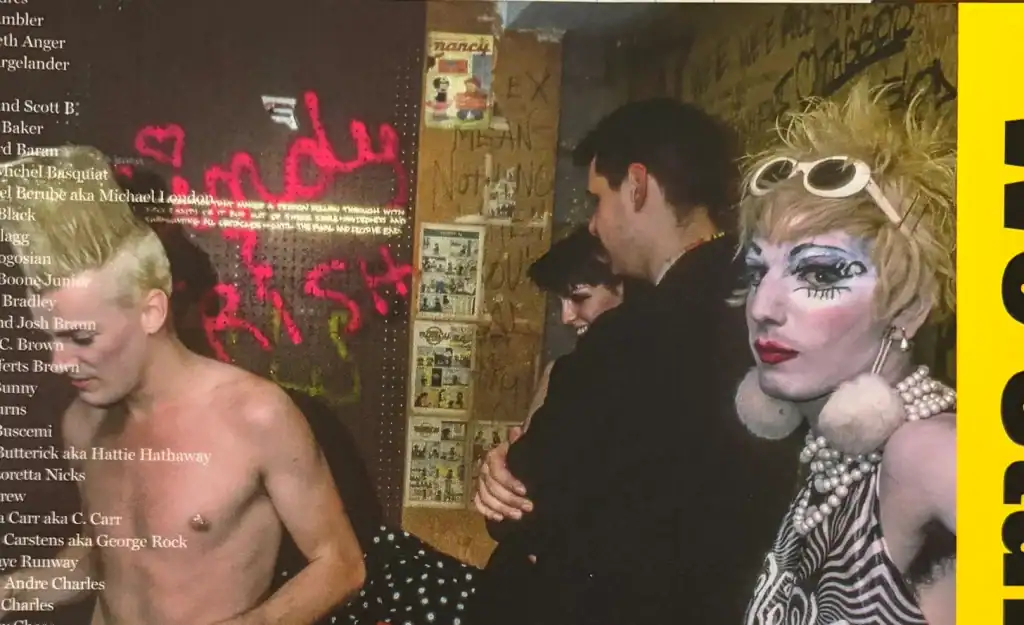
Thoughts inspired by ” ‘We Started a Nightclub’: The Birth of the Pyramid Cocktail Lounge as Told by Those Who Lived It” from Brian Butterick, Susan Martin, and Kestutis Nakas
I’m fascinated by those rare phenomena in which the artistic avant-garde, deviant subcultures of style, bohemia, and people otherwise on society’s fringe briefly meet, cross-pollinate, and then collectively flame out while changing the course of cultural history. I call them extreme scenes.
Because of their hedonism and theatricality, extreme scenes often revolve around nightclubs. Think of Eldorado in Weimar-era Berlin with its transgressively LGBTQ+ cabaret. Recall Max’s Kansas City, a magnet for artists, musicians, and their out-on-the-edge entourages debauching or on the make in sixties and seventies New York. Likewise Taboo in 1980s London, where the unclassifiable designer?-artist?-dancer? Leigh Bowery debuted the outrageous ensembles that made him stand out as well as fit right in. But the main meeting place could also be a bar, unproven art gallery, living room, café, off-hours church basement, or website.
Extreme scenes cultivate art and behavior too outré—or illegal—for more established venues. But eventually they gain recognition for the wider impact they make on fashion, music, art, literature, film, or theater. Also, often, for being the drivers and victims of gentrification.
I’ve paid attention since childhood. Earlier than most minors I appreciated camp irony and drag performance, having learned about gay-nightclub acts and John Waters films from author friends of my parents. As a young adult, my living situations, clubbing, and dating gave me glimpses into lives more danger-filled than mine. When I became a historian of modern and contemporary art, I learned of extreme scenes playing germinal roles. That drove me to explore the field of cultural studies, where Dick Hebdige’s book on British Punk, The Meaning of Style, sparked my interest in the social organization of nonconformity. My own publications required related research. For Unpackaging Art of the 1980s and Meet Me at the West Beach Café, I investigated cultural undergrounds in seventies and eighties New York and Los Angeles. For “The Other Bohemia,” I mined the title concept for how it might apply to a subculture of the entertainment industry in the aughts.
For someone who’s never been an actual member, I’ve thought about extreme scenes an awful lot. With critical distance as much as admiration, I’ve tried to figure out what makes them tick.
When I read “We Started a Nightclub”: The Birth of the Pyramid Cocktail Lounge as Told by Those Who Lived It, I was moved to try again. The book remembers the Pyramid club on the Lower East Side of Manhattan from 1981 through 1986. Those were the club’s earliest, most innovative and influential years, mostly under the direction of founder, alchemical mixer of worlds, and enthusiastic booker of far-out performers—the late Bobby Bradley.
In three main parts—corresponding to the club’s establishing years, a “full swing” phase, and the transition away from Bradley’s management—the book builds a rich portrait of the Pyramid, its neighborhood, and the figures and relationships animating them. With abundant photos of people and performances, interviews with participants, interstitial narratives, and reprints of club publicist Susan Martin’s provocative press releases, the book interweaves a remarkable range of details and perspectives without losing narrative thread.
Although it stands out for extensive representation of just one case, the book inspired me to make some long-brewing observations* about extreme scenes in general.